
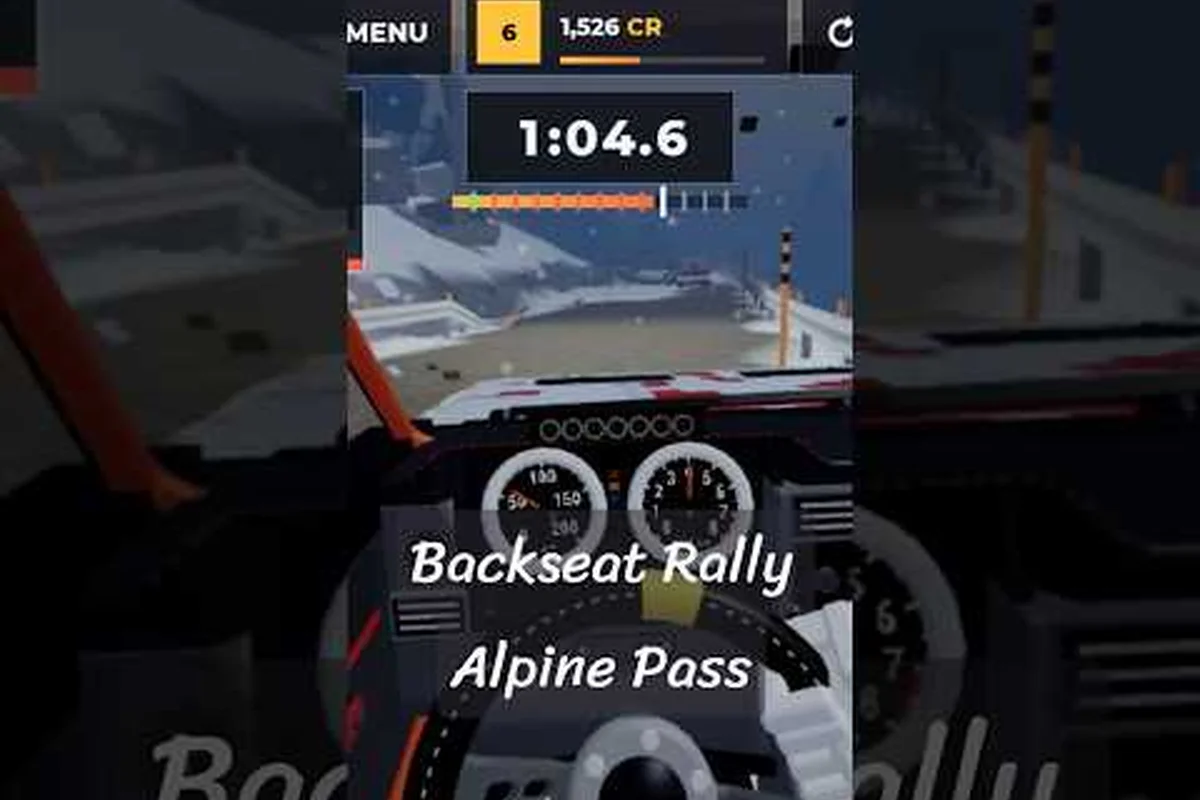
The Backseat Rally rain stage rewards early braking, controlled throttle, and smart mud management. A clean route matters because every avoidable slide costs precious tenths: use this Backseat Rally stage guide to turn slippery corners into reliable medal runs and chase gold times without gambling on grip.
Backseat Rally Rain Stage Route and Conditions
The Backseat Rally rain stage is best treated as a momentum test rather than a straight-line speed challenge. Water, mud, and off-camber ground reduce the amount of time you can safely recover from a mistake, so the most effective line is usually the one that keeps the car composed through each checkpoint instead of the one that looks shortest on the map.
A verified community record run by GakuranBoy demonstrates the key pattern: brake early before the off-camber sections and keep the throttle steady through deep ruts. You can study that approach in the Stage 5 Backseat Rally record run, which focuses on the mud cross and the moment momentum must be preserved.
Surface Types and Driving Responses
Different patches of the Backseat Rally mud stage demand different inputs. A surface that seems solid in the preview can still be wet, while a muddy rut may offer useful traction if approached with a stable, measured throttle rather than a sudden correction.
| Surface condition | Main risk | Better driving response |
|---|---|---|
| Puddled straight | Hydroplaning | Keep the car aligned and avoid abrupt steering |
| Shallow mud | Loss of forward drive | Apply throttle progressively rather than all at once |
| Deep rut | Sudden yaw or wall impact | Smooth the steering and maintain steady momentum |
| Off-camber bend | Slide toward the lower edge | Brake earlier and settle the car before turning |
| Wet exit | Wheelspin on acceleration | Unroll the throttle as grip returns |
The broader effects of wet and muddy conditions are covered in the Backseat Rally weather guide, but the key principle is simple: the rain stage rewards restraint. A lower peak speed can produce a better final time when it prevents a spin, wall strike, or restart.
Checkpoint Priority
Checkpoints divide the rain stage into manageable sections, so treat each one as a fresh mini-run instead of carrying every mistake forward. After each split, compare your line, speed, and elapsed time with the previous attempt: a cleaner checkpoint may gain more than reckless speed, especially where traction changes from wet tarmac to deep mud. This checkpoint-by-checkpoint approach makes a backseat rally gold time easier to chase, because you can identify whether lost time comes from a cautious launch, a bad line through standing water, or an avoidable slide before the final split.
| Checkpoint type | What to protect | Common mistake |
|---|---|---|
| First stage checkpoint | Clean start and momentum | Launching with excessive wheelspin |
| Mud section checkpoint | Stable direction | Fighting the steering over a rut |
| Off-camber checkpoint | Control on the tilted surface | Braking too late and loading the outside wheels |
| Final checkpoint | Clean finish | Rushing the last corner for a few tenths |
The first checkpoint deserves special attention because a slippery launch can consume several seconds before the road even becomes difficult. Build enough speed on a clean section, shift smoothly, and avoid a high-slip start that leaves the car waiting for grip.
Backseat Rally Rain Stage Driving Technique
Success on the Backseat Rally rain stage comes from controlling the car’s weight transfer. Braking, acceleration, and steering all interact on a wet surface, and doing them in a stable order makes the vehicle easier to catch. Players who overcorrect one input often create a second problem while trying to solve the first.
Braking in Standing Water
The most useful habit is to early-brake rhythm: release the accelerator, brake before the corner entry, and straighten the wheel slightly as the car slows. This reduces the chance that grip will disappear while the front end is already turned.
Do not try to simulate a perfect single wheel track. In standing water, the surface under each wheel may differ, and a small steering correction can become a large yaw. The goal is to keep the car settled enough for the back end to follow, not to force a perfect line through every puddle.
The Backseat Rally wet-weather driving guide expands on the broader technique. For this stage specifically, use it as a reference for smooth inputs rather than a reason to brake dramatically earlier than the corner requires.
Mud and Wheelspin Management
Progressive throttle is the defining technique for the mud sections. When the rear wheels begin to spin, the driver should not stab the throttle again. Maintain a steady input, reduce steering changes, and allow the car to settle into the rut.
This approach can feel slow during the first attempt because visual speed and actual progress may differ on a muddy surface. A spinning car may look busy without moving far, while a controlled application can carry the vehicle steadily through the roughest section. That distinction becomes crucial when comparing Backseat Rally medal times.
| Situation | Less effective input | More effective input |
|---|---|---|
| Rear tires lightly slip | Tap the throttle repeatedly | Hold a small, even throttle setting |
| Deep rut opens ahead | Turn hard and accelerate | Let the car settle, then add power gradually |
| Car begins to yaw | Make a large steering correction | Ease off and let the grip recover |
| Mud becomes firm again | Stay cautious and lose momentum | Unroll the throttle promptly |
Steering Corrections and Weight Transfer
Small corrections are usually more effective than large ones. When the car slides on an off-camber bend, pull the correction in gradually and let the tires find grip. A sudden opposite input can unload the rear even further, especially if the driver also adds power at the same time.
A useful sequence is: ease off the throttle, pause the steering input, then add power again only as the car straightens. On a rain stage, this gives the rear tires a chance to regain traction instead of fighting a slide, while a small steering correction preserves the line. For example, if the car begins to rotate on a wet, off-camber bend, reducing power before turning sharply can prevent the rear from becoming light and sliding wide toward the runoff.
-
Release pressure from the accelerator when the rear begins to move.
-
Unwind the steering slightly if the car is rotating too far.
-
Wait for a response from the suspension and tires.
-
Reapply power once the car points through the bend.
-
Exit only after the tires are connected, rather than merely because the corner appears to end.
That sequence can cost only a few tenths, but spinning, crossing the runoff, and attempting recovery can erase a gold-time run on a short rain stage. In Backseat Rally, preserving the racing line is usually worth more than chasing a fraction of a second in one corner: a stable exit keeps momentum toward the next split, while a slide may cost several seconds in penalties and recovery. On a muddy stage, the extra caution also reduces the chance of a wall strike or an unrecoverable off-track excursion, so judge the corner by the car’s response and the remaining stage distance rather than by a single moment of slide angle.
Backseat Rally Mud Stage Line Choice
The best line in the Backseat Rally mud stage is not always the geometrically shortest line. A path through firm ground may be a few meters longer but deliver the car to the next bend with more speed and stability. The correct choice depends on the surface beyond the apex, not just the dirt immediately beside the car.
Fast, Safe, and Mud Lines
| Line type | Surface benefit | Limitation | Best use |
|---|---|---|---|
| Fast line | Shortest distance | Exposes more of the car to deep ruts | Clean, dry-weather runs |
| Safe line | Better traction and visibility | Adds distance and may reduce speed | Medal attempts in heavy rain |
| Mud line | Uses the vehicle’s momentum through soft ground | Can punish abrupt steering | When the rut direction matches the exit |
Checkpoint-first routing means choosing the line that reaches the next checkpoint with a clean landing. If a mud rut exits directly into a puddle, taking the longer firm line may preserve more speed. If the rut points directly toward the next corner, it can become the fastest and most natural route.
Watch the road edges as well as the center. The hardest part of a wet bend is often the transition where the car leaves a muddy area and suddenly reaches a smoother, more predictable surface. A wide line on entry and a controlled early throttle can prevent that change from catching the rear unexpectedly.
Comparing Medal Routes
Medals are awarded against fixed stage targets, so the practical goal is to reduce time without creating a large variance. A run that sets a personal best but also produces three spins may be less useful for improvement than a slightly slower run with one repeatable mistake.
| Route choice | Typical time outcome | Risk level | Medal usefulness |
|---|---|---|---|
| Aggressive shortcuts | Excellent when clean | High | Best for exceptional runs |
| Balanced racing line | Consistent under rain | Medium | Best for learning and repeated medal attempts |
| Conservative detour | Usually slower | Low | Useful for completing the stage and identifying faults |
Because exact Backseat Rally gold times can vary by platform, version, or difficulty setting, use the targets displayed in your own stage interface as the authority. Community runs remain useful for comparing technique, but they should not override the medal thresholds shown to the player.
Backseat Rally Gold Times and Medal Strategy
A medal run is built through repeatable segments. Rather than chasing a large improvement immediately, record the time at each checkpoint, compare it with your best previous run, and determine where the largest loss occurred. This is the most useful approach to the process of earning gold on a wet stage because it turns a difficult run into a series of solvable problems.
A Practical Medal Time Plan
Use a consistent rhythm for every run: first review the rain-stage route and medal target, then execute the run using the same sequence before, during, and after each attempt. In Backseat Rally, conserving momentum through muddy ruts, avoiding steering fights, and waiting for grip on off-camber sections can preserve time more effectively than forcing a faster line. After the run, use the checkpoint comparison to identify where the largest time loss occurred and choose one specific correction for the next attempt.
| Phase | Action | Purpose |
|---|---|---|
| Before the run | Review the route and medal target | Establish where time can be lost |
| Early stage | Prioritize a clean launch and stable line | Avoid giving away time in traffic |
| Mud section | Smooth throttle and avoid steering fights | Preserve momentum through deep ruts |
| Off-camber section | Brake earlier and settle the car | Prevent a slide toward the edge |
| Final sector | Commit only after grip is established | Finish cleanly instead of forcing a spin |
| After the run | Compare each checkpoint | Identify the highest-value correction |
Checkpoint-by-checkpoint analysis is more productive than simply replaying the whole run in your mind. A five-second loss concentrated at one muddy bend can often be reduced through one change, while a broad attempt to drive faster everywhere can introduce errors in several corners at once.
What Separates Medal Times?
A medal run usually combines lower peak speed with less wasted motion. The driver brakes in a predictable place, avoids unnecessary steering, and uses only as much throttle as the surface allows. That sounds modest, but it reduces the time lost to slides, corrections, and contact.
| Time factor | Slow approach | Medal approach | Result |
|---|---|---|---|
| Corner entry | Last-second braking | Earlier, smoother braking | More stable rotation |
| Mud acceleration | Chasing the rev limiter | Progressive throttle | Better forward progress |
| Steering | Constant large corrections | Small linked inputs | Less yaw and wall risk |
| Recovery | Aggressive countersteer | Brief pressure release | Faster return to the line |
| Finish | Rushing the last checkpoint | Clean pass through it | Avoids a costly reset |
A useful mental model is three-stage control: settle the car before the turn, rotate it through the turn, and reconnect the power on exit. Beginners often focus only on the first stage, but gold medal times depend on completing all three without losing speed.
Backseat Rally Rain Stage Walkthrough
This Backseat Rally stage walkthrough focuses on the correct decision at each major hazard. It does not depend on one universal braking point, because the ideal point changes with the wet-weather setup, surface wear, and the entry speed carried from the previous corner.
Start to First Mud Bend
Accelerate smoothly rather than forcing a fast launch. Once the car reaches the first bend, release the throttle and brake before the steering loads up. If the turn leads into mud, finish most of the braking on the firmer approach so the car is already stabilized when the rear wheels reach the soft section.
The main mistake is carrying excessive entry speed into a surface change. A faster arrival may feel productive, but it leaves no margin for correcting a puddle or rut. The best line is the one that keeps the car moving after the turn, not the one that reaches the apex first.
Deep Ruts to Off-Camber Exit
Deep ruts reward patience because steering changes can make the car move in a direction different from the intended path. Aim into the rut, reduce the amount of steering, and maintain a steady throttle. Once the surface firms, add power gradually and prepare for the off-camber exit.
At the transition, brake before the lower edge becomes a problem. The car will feel as though it wants to continue outward, so avoid a hard steering input that loads the tires against the camber. A modest reduction in speed can preserve both alignment and exit momentum.
Final Section and Checkpoint
The final section often tempts drivers to exceed the speed limit after a difficult mud sequence. Resist that impulse because the checkpoint must be reached cleanly, not merely touched after a dramatic slide. Carry a controlled pace through the last bend, align early, and drive through the checkpoint without correcting away from the finish.
That final discipline is reflected in community records: the verified run shown earlier prioritizes early braking, steady throttle, and momentum through the rut rather than a last-corner gamble. The fastest-looking moment is often less valuable than the cleanest final lap.
Fine-Tuning the Backseat Rally Rain Stage
Once you can finish consistently, improve the stage in small, measurable changes. Adjust one behavior at a time because changing the line, braking point, and throttle input together makes it difficult to identify what improved the run. Record the result after every meaningful change, and keep the version that works without constant correction.
Tuning Checklist
| Adjustment | Test condition | Keep it if |
|---|---|---|
| Earlier braking | Wet bend with stable exit | Corner time falls and the car stays aligned |
| Later braking | Dry-looking but slick entry | The car remains planted and reaches the apex faster |
| Lower mud throttle | Deep rut or loose surface | Forward speed improves without excessive wheelspin |
| Wider entry line | Off-camber corner | The car keeps more grip and loses less exit speed |
| Tighter entry line | Clear, firm section | The shorter line does not force a correction |
Consistency scoring is useful when medal times are close. Count spins, wall contacts, missed checkpoints, and large steering corrections. A run with no errors can be worth more than a slightly faster but unstable attempt, and it usually becomes faster after a few more controlled repetitions.
Players can also review how weather changes speed, braking, and cornering in the weather-mechanics reference. That knowledge is especially useful if the stage’s rain behavior differs from another muddy event, because the important principle remains the same: trust the surface feedback rather than applying the same throttle map everywhere.
When to Prioritize the Mud Section
Prioritize the mud section when the backseat rally rain stage repeats nearly the same time loss after a deep rut. That pattern usually means the car’s entry line or throttle timing is wrong, not that the mud surface itself is simply slow. For example, if the crew enters with too much speed, the first steering input can trigger sudden wheelspin; if power is applied too abruptly, the car may crawl out and lose more time. Watch the split times and compare the mud-section exit with the final-sector result: a strong start followed by a slower finish points to an entry-speed or traction problem, while a smooth rut exit followed by an inconsistent final bend shifts priority elsewhere. Use the table below to identify the specific fault before adjusting your rain-stage line, since small corrections to entry speed, throttle, and steering can preserve gold times on a backseat rally stage.
| Symptom | Likely cause | Adjustment |
|---|---|---|
| Slide after the rut | Entry speed too high | Brake slightly earlier |
| Car barely exits the rut | Throttle too abrupt | Smooth the power application |
| Frequent left-right correction | Steering too sharp | Aim more directly and ease the wheel |
| Strong start, poor finish | Corner-entry overrun | Reduce speed before the transition |
The opposite is true when the mud section is already clean but the final bend is inconsistent. In that case, focus on the off-camber transition and preserve a stable exit. The largest remaining time loss deserves attention before shaving fractions from an already efficient segment.
Frequently Asked Questions
What is the best line for the Backseat Rally rain stage?
The best line stays composed through wet transitions, uses firm ground when it prevents a costly slide, and follows deep ruts only when they point toward the next corner. Brake earlier than usual, avoid abrupt steering, and maintain smooth throttle so the car retains momentum. A slightly longer safe line can outperform a short fast line that ends in a spin.
How do I get gold in the Backseat Rally rain stage?
Compare each checkpoint with your best previous attempt and identify the largest time loss. Most gold medal runs become possible by fixing one repeated error, such as late braking on an off-camber turn or oversteering in a rut. Use the medal target displayed in your own stage interface, because exact gold thresholds may vary by platform or difficulty.
Should I use more throttle in the Backseat Rally mud stage?
Not at first. Begin with a smaller, steadier throttle input and let the car pull through the rut before increasing power. If the rear wheels spin continuously, reducing pressure and straightening the car can create more progress. A controlled input usually beats repeatedly stabbing the accelerator, especially through the deepest section.
Are Backseat Rally medal times based on the fastest possible lap?
They are based on fixed stage targets, but a record-style run is not always the best practice run. A slightly slower lap with no spins is more useful for learning because it shows which sections can be improved. Once the route is repeatable, use faster lines and later braking points to close the gap to the displayed target.
What should I change after hitting a wall on a wet bend?
First, determine whether the wall strike came from late braking, excessive entry speed, or a steering correction. Slow the approach and brake before the turn loads up. If the surface is muddy, keep the throttle steady and make smaller steering inputs. Do not immediately add more power after contact; first restore a stable line and clean exit.