
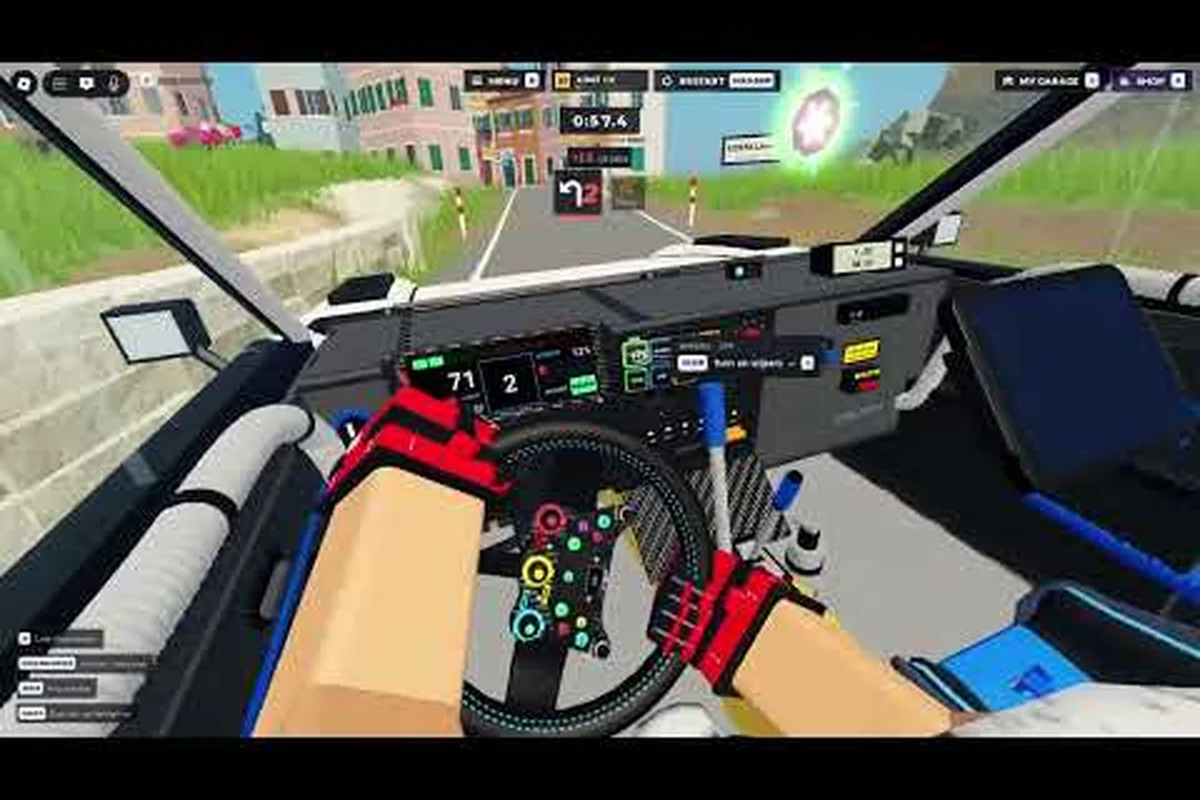
Backseat Rally how weather works can decide a clean run or a costly mistake, so every surface condition deserves a deliberate driving plan. Learn the callouts, speed changes, and braking habits that turn wet, snowy, and muddy stages into manageable routes.
Backseat Rally Weather: Conditions Over Cosmetic
Weather in Backseat Rally is more than a visual effect. It changes the conditions under which the car must accelerate, brake, and turn, which means the same throttle input or racing line may produce a different result from one stage to the next. Understanding surface grip and weather severity gives drivers a repeatable reason to adjust before a corner becomes a recovery job.
A useful Backseat Rally condition guide starts with three questions: Is the surface wet, loose, or slippery? How much visibility is available? Where will the car need to shed speed? The answers should shape a simple driving plan before the stage begins.
| Weather condition | Main driving challenge | Best early adjustment | Common mistake |
|---|---|---|---|
| Rain | Reduced grip and longer braking | Lower entry speed and brake earlier | Braking at the old dry-road point |
| Snow | Very low traction and slow steering response | Smooth inputs with extra stopping distance | Sudden steering or hard braking |
| Mud | Limited traction with loose surface movement | Keep the car settled and avoid abrupt power | Spinning the wheels while cornering |
| Clear | Maximum control and visibility | Plan the ideal racing line | Ignoring that conditions may change |
The key principle is predictable movement. Weather penalties become much easier to handle when the driver commits to small, early corrections rather than relying on a late emergency input. That approach also makes the broader weather and grip guide useful for comparing the feel of each surface.
Reading a condition before the start
The most valuable weather information appears before the car moves. A stage preview, route label, or visible atmosphere can warn the driver that rain, snow, or mud is present. Instead of treating the notice as flavor text, translate it into a concrete limit for the upcoming corners.
-
For rain, assume a longer stopping distance and less confident turn-in.
-
For snow, prioritize smooth steering and even braking.
-
For mud, favor a steady line and avoid sudden acceleration.
-
For clear weather, use the stage to refine rhythm and save tires for later conditions.
Pre-stage condition planning is a repeatable advantage because it prevents a driver from entering the first hazardous corner at a speed that would already be reasonable on dry pavement. Before committing to that speed, check the co-driver’s weather callout against the visible road surface and the stage preview: rain can make the same braking point arrive earlier, snow reduces usable grip, and mud can drag the car off the intended line. Treat the first corner as a calibration point, not merely a restart: make one controlled input, compare the car’s response with the announced condition, then adjust pace, braking, and throttle for the remaining stage. This is how a weather penalty becomes a measurable limit rather than a vague warning.
Rain, Snow, and Mud: Comparing Weather Penalties
The three principal bad-weather conditions affect the car in different ways. Rain mainly reduces the amount of grip available when braking and turning. Snow makes both acceleration and directional control more delicate. Mud introduces a loose-surface feel and can make abrupt input feel unproductive. Because the penalties are not interchangeable, copying one condition’s driving pattern into another can cost more time.
Rain: Manage stopping distance first
Rain is often the easiest bad condition to recognize, yet it can still punish late braking. A wet road may provide less friction than a dry one, so the same braking zone can need to begin earlier. The practical penalty is not simply “drive slower”; it is reduced braking authority, which makes stopping-point decisions less forgiving.
The following comparison is a conceptual driving model based on community testing rather than an official speed formula. It helps explain why Backseat Rally speed in rain should be reduced gradually rather than replaced by one fixed “rain speed”: as conditions worsen, the usable weather penalty rises while available grip and braking authority fall. For example, a light shower may call for a modest reduction, whereas standing water can justify a larger change because early braking needs more distance and mid-corner adjustments become less predictable. The useful target is a controllable speed that preserves options, not a memorized number.
| Rain response | What the driver feels | Recommended correction |
|---|---|---|
| Early braking | Controlled deceleration with less lockup risk | Move the braking point earlier |
| Mid-corner braking | Unstable or sliding entry | Brake before turn-in |
| Throttle while turned | Reduced traction and possible push | Unweight the car before adding power |
| Sudden steering | Overreaction through the corner | Use a smaller steering input |
A braking-before-turning habit is the safest general approach in rain. It gives the tires time to slow the car while the car is still aligned with the road, then lets the driver add steering as the corner develops. The wet-weather and winter-driving reference expands this distinction into practical preparation for several difficult surfaces.
Snow: Smoothness matters more than force
Snow demands a different kind of restraint. A hard steering input can disturb the car’s movement, while aggressive braking can reduce the ability to control the slide. The best response is generally a sequence of small corrections: release some pressure, settle the car, and allow it to follow the intended line.
| Snow condition | Risk | Better response |
|---|---|---|
| Locked or nearly locked wheels | Loss of steering control | Ease off the brake and restore grip |
| Sudden countersteer | Larger slide than expected | Apply a measured correction |
| Full throttle on a steep slope | Wheelspin or stalled momentum | Feed in acceleration gradually |
| High-speed entry | Too much distance to adjust | Slow the car well before the apex |
Snow rewards input smoothing. A driver who holds the car steady through a bend may lose less time than one who makes a dramatic correction and has to recover. The central measure is confidence in the car’s direction, not how hard the pedals are being pressed.
Mud: Keep the car from working against itself
Mud feels different from a clean, low-grip surface because the tires may work against loose material rather than simply sliding over a hard surface. The practical penalty is reduced progress, especially when the driver adds power while the car is already loaded sideways. Wheel-spin recovery therefore depends on reducing excess input and regaining a settled attitude.
| Mud situation | Likely result | Driver action |
|---|---|---|
| Accelerating in a straight line | Useful momentum if the surface is firm enough | Keep steering corrections small |
| Adding power mid-corner | Loss of direction and shallow progress | Straighten slightly before accelerating |
| Entering with too much speed | Wide line and excess momentum | Brake earlier and carry less entry speed |
| Churning at a standstill | Little forward movement | Reduce input and use a cleaner line |
These distinctions are why a Backseat Rally weather penalty should be treated as a surface-specific loss of control, not as one universal reduction applied to every kind of bad weather. Rain can reduce grip while preserving steering response, snow can make braking distance unpredictable, and mud can add drag as the tires dig into loose ground. That means the Backseat Rally speed in rain guidance can differ from Backseat Rally braking in snow or Backseat Rally cornering in mud: the driver’s inputs must respond to the actual surface problem, such as earlier braking in snow or less power while crossing soft mud.
Callouts, Visibility, and the Condition Timeline
Backseat Rally weather callouts are most useful when they occur early enough to affect a decision. A warning that appears just before a hazardous corner can confirm the danger, but it cannot undo an entry speed that was already too high. The best response is to connect each callout with a future action: brake earlier, smooth the steering, or settle the car before acceleration.
A stage may also move through changing conditions, so drivers should reassess their assumptions rather than treating a route as permanently wet, snowy, or muddy. A sunny opening can still conceal a cold or wet section farther ahead. A rain warning near the start may describe only the first portion of the route.
| Callout timing | Immediate interpretation | Best preparation |
|---|---|---|
| Far before the hazard | Time to adjust the whole approach | Choose a lower approach speed and alternate line |
| Shortly before the hazard | Limited reaction room | Commit to the safe line without late correction |
| During the hazard | Driver must manage an active slide | Ease inputs and recover direction smoothly |
| After the hazard | Penalty already paid | Reset speed and avoid carrying the error forward |
Condition duration matters because a brief muddy patch should not affect the entire stage, while persistent rain should influence every stop from the beginning. Players can consult the stage-specific weather overview for the relationship between route conditions and preparation.
Turn warnings into concrete actions
A callout should produce a specific response rather than a vague feeling that the road is dangerous. For example, rain means “increase my stopping margin,” snow means “make every input smaller,” and mud means “avoid asking the tires to do two things at once.” This translation makes the information actionable even when the route display does not provide a numerical penalty.
The same rule applies to visibility. A weather callout can be followed by fog, spray, or a darker horizon that reduces the distance at which hazards become visible. In that case, the driver should rely on familiar braking points and avoid making a sudden change of plan at the last moment.
Callout-to-action translation is the safest way to handle uncertain terrain because it links each announcement to an input you can actually make: reduce speed before the condition appears, add extra braking distance in rain, smooth steering in snow, and choose a cleaner line in mud. This matters because Backseat Rally weather penalties change the risk of ordinary inputs, so a warning becomes useful only when it tells the co-driver whether to ease off, brake earlier, or wait for a safer section of road.
Adjusting Speed, Braking, and Cornering
Weather changes the relationship between speed and available grip, so speed reductions should happen before the danger becomes critical. The biggest time loss usually comes not from traveling slowly, but from entering a corner too quickly, sliding, and then trying to recover. A measured pace is often faster over the full stage.
Use a three-zone speed plan
Divide the route into three speed zones: set the approach speed from the braking distance and road-surface grip, treat the hazard zone as the point where steering, braking, and throttle must remain coordinated, and reserve the recovery zone for rebuilding momentum after the car is stable. In rain, a lower speed can preserve tire grip and leave time to correct a slide; in snow, earlier braking reduces the chance of locking the wheels; in mud, holding a firm line limits abrupt changes in traction. This zoned plan turns weather conditions into a Backseat Rally speed decision rather than a single arbitrary limit.
-
Approach zone: Choose a speed that leaves room to brake before the hazard.
-
Hazard zone: Match steering, braking, and throttle to the current surface.
-
Recovery zone: Rebuild momentum only after the car is stable and aligned.
This structure works in rain, snow, and mud because it separates speed management from active control: set a safe entry speed in the approach zone, then focus on coordinated steering, braking, and throttle through the hazard zone. For example, in rain, an earlier approach-speed reduction gives the tires more time to regain grip; in snow, earlier braking avoids wheel lock; and in mud, a firm line reduces sudden traction changes. Once the car is stable and aligned, the recovery zone restores momentum gradually, so a small slide does not become a multi-corner error or an unnecessary weather penalty.
| Speed zone | Main objective | Rain | Snow | Mud |
|---|---|---|---|---|
| Approach | Arrive with a margin | Brake earlier | Brake very early | Choose the firmest available line |
| Hazard | Keep the car controlled | Reduce steering sharpness | Keep inputs smooth | Avoid abrupt power |
| Recovery | Restore momentum | Accelerate straight | Ease into throttle | Settle before full power |
The relevant target is not simply a lower number. It is a speed that leaves enough room for the next correction. That is why Backseat Rally speed in rain should be treated as a planning variable, while snow and mud demand even more attention to the car’s balance.
Brake earlier, but brake progressively
Earlier braking is useful only if the braking input remains controlled. Locking up or making a sudden stop can unsettle the car on any slippery surface. Use progressive pressure where possible, and straighten the car before asking for maximum deceleration when the road allows it.
Braking margin should increase as grip falls. A driver who remembers the dry braking point on a wet surface is using the wrong reference. The better method is to move the braking point earlier by a visible amount and check whether the car settles cleanly.
Cornering in mud with less conflict
Backseat Rally cornering in mud becomes more efficient when steering and power do not compete. If the car is pointing toward the apex but still moving sideways, adding throttle can make the rear dig, widen the line, and reduce useful speed. Straightening slightly and then feeding in power often creates a cleaner exit.
| Cornering error | Why it costs time | Better correction |
|---|---|---|
| Early power in a tight bend | Rear may lose traction or dig into mud | Delay acceleration until the car is aligned |
| Steering while applying hard power | Inputs compete for limited traction | Separate steering and throttle |
| Late correction | The slide has already developed | Look farther through the bend and make smaller changes |
| Full lock on a stable car | Causes unnecessary instability | Use measured steering unless recovery is required |
Load balance is the practical idea behind these corrections: keep the car settled, release conflicting inputs, and then restore momentum in a controlled way. In a mud corner, that means briefly reducing steering or power once the car is moving sideways, allowing the tires to regain bite before accelerating again. For example, if the rear starts to dig under hard throttle, easing off can straighten the car’s attitude; once it points toward the apex, measured steering and gradual power restore speed without widening the line. This is especially important in Backseat Rally weather conditions, where a small traction error can turn a quick corner into a longer recovery.
A Practical Backseat Rally Condition Guide for Each Surface
The best weather strategy is not a list of isolated tricks. It is a consistent routine that turns surface information into speed, braking, and cornering decisions. Use the same sequence for every stage: identify the condition, estimate the grip loss, plan the approach, then drive one input at a time.
The five-step routine
-
Read the route: Note every weather callout and the likely surface type.
-
Find the first hazard: Identify the first corner or obstacle that will test grip.
-
Set a lower reference speed: Use a familiar dry-stage section as the baseline, then reduce it.
-
Reserve braking distance: Move the braking point earlier and avoid last-second inputs.
-
Reassess after the hazard: Rebuild confidence gradually instead of assuming grip returns instantly.
| Surface | Main priority | Avoid | Recovery cue |
|---|---|---|---|
| Rain | Early, smooth braking | Late braking and hard cornering power | Car straightens and tires regain grip |
| Snow | Minimal steering and pedal inputs | Sudden countersteer and heavy braking | Car tracks the intended line again |
| Mud | Clean direction and controlled power | Accelerating while heavily off-line | Front wheels regain a clear pull |
| Mixed route | Frequent reassessment | Assuming one condition lasts all stage | New surface becomes visible or announced |
This routine is especially helpful on a stage with alternating surfaces. The dynamic-weather and terrain overview is a useful companion for routes where rain, snow, mud, gravel, and dry sections may appear in sequence.
A run example in changing conditions
Imagine a stage begins in rain, enters a long left-hander, and then continues into a muddy section. The correct approach is to reduce speed before the first corner and brake in a straight line. After the bend, the driver should not immediately return to full throttle because the next surface may offer less grip.
Treat the weather penalty as a changing grip budget, not a fixed speed reduction: rain, snow, and mud each alter braking, traction, and throttle response differently. For example, in the rainy left-hander, arriving slowly gives the co-driver time to identify the puddle before turn-in, while braking in a straight line preserves the rear tires’ ability to rotate the car through the corner. In the muddy section, early acceleration can break traction, so the useful sequence is to settle the car, read the surface change, then release power only when the road provides enough grip.
-
Use a controlled entry speed for the wet corner.
-
Finish the turn without demanding abrupt power.
-
Notice the change in color or surface texture before the mud.
-
Select the cleanest available line and accelerate gently.
-
Carry only the confidence the new surface supports.
This example shows why the weather penalty is more than a simple speed reduction: it changes the grip budget available for every input and therefore the rhythm of the whole stage. Braking must finish before turn-in, rotation has to stay within the tires’ available traction, and throttle can resume only after the car is settled and the new surface can support it. A weather callout that is one second late can force an avoidable slide or leave the crew braking too late for the corner ahead.
Common Weather Mistakes and Recovery Techniques
Most costly mistakes come from one of four habits: trusting a dry reference point, reacting late, mixing incompatible inputs, or failing to reset after a slide. The recovery technique depends on the condition, but the first principle is shared: reduce conflicting input before making a dramatic correction.
| Mistake | Immediate risk | Recovery method |
|---|---|---|
| Braking at the dry-line point | Reduced grip causes an overshoot or slide | Move off the brakes, align the car, and brake again earlier next time |
| Steering hard in snow | A small slide can become a spin | Ease the steering and let the car settle |
| Applying power in a muddy turn | The line widens and progress drops | Straighten, reduce throttle, then reapply power |
| Holding full speed through a warning | No room remains for correction | Reset speed as soon as the hazard is visible |
Recovering without compounding the error
After a slide, the first goal is not to regain maximum speed immediately. It is to restore a stable direction. That often means releasing the brake, reducing steering input, or easing off the throttle until the car settles. Once stability returns, the driver can choose a gentler exit rather than trying to repay all lost time in one burst.
Rain recovery is often about reducing speed and following the road. Snow recovery may require a small, patient steering correction. Mud recovery usually benefits from letting the chassis settle before feeding in acceleration. The exact input depends on the car’s attitude, so drivers should avoid treating any one correction as a universal formula.
Recovery patience is valuable because a controlled exit preserves the next corner’s grip and momentum. If the car is still sliding in rain, snow, or mud, chasing pace with abrupt throttle can cause a second error, such as understeer over the outside curb or a spin into the runoff. In a weather callout, prioritize rebuilding stability first; the faster line may even be the slower, cleaner route before conditions improve.
Frequently Asked Questions
Does Backseat Rally weather change the car’s grip?
Yes. Rain reduces available traction around braking and cornering, snow makes steering and acceleration more delicate, and mud reduces the usefulness of abrupt inputs. Exact behavior can vary by version and surface, so treat this condition guide as practical driving guidance rather than a fixed numerical formula.
What is the best way to handle rain in Backseat Rally?
Brake earlier than you would on dry pavement, keep the car mostly straight while slowing, and make smooth steering corrections. The key idea behind Backseat Rally speed in rain is not a single posted limit; it is leaving enough distance for the reduced braking authority available on a wet surface.
Should I use the same braking style in snow as in mud?
No. Snow generally calls for smaller steering and brake inputs because the car is easy to disturb. Mud also requires low conflict between controls, but the main priority is preventing wheelspin and maintaining a clean line. Smooth snow driving differs from mud-driving progress management.
What do Backseat Rally weather callouts mean for route planning?
They are early warnings that specific sections may have reduced grip or altered road conditions. Treat each callout as a prompt to identify the next hazard, lower the approach speed, and choose a braking point before the affected turn. A callout cannot safely replace a full route inspection.
Can I recover quickly after sliding on a wet or snowy road?
Often, but speed comes second to stability. Release conflicting inputs, reduce steering or brake pressure as needed, and let the car settle before rebuilding momentum. For a stage-specific reference, the rain-stage driving guide explains how weather can affect medal and gold-time attempts.
Weather mastery comes from connecting each surface to a clear action: brake earlier in rain, smooth every input in snow, and avoid competing steering and power in mud. Master that sequence, treat callouts as route information, and every hazardous stage becomes a more controllable version of the driving challenge you already know.