
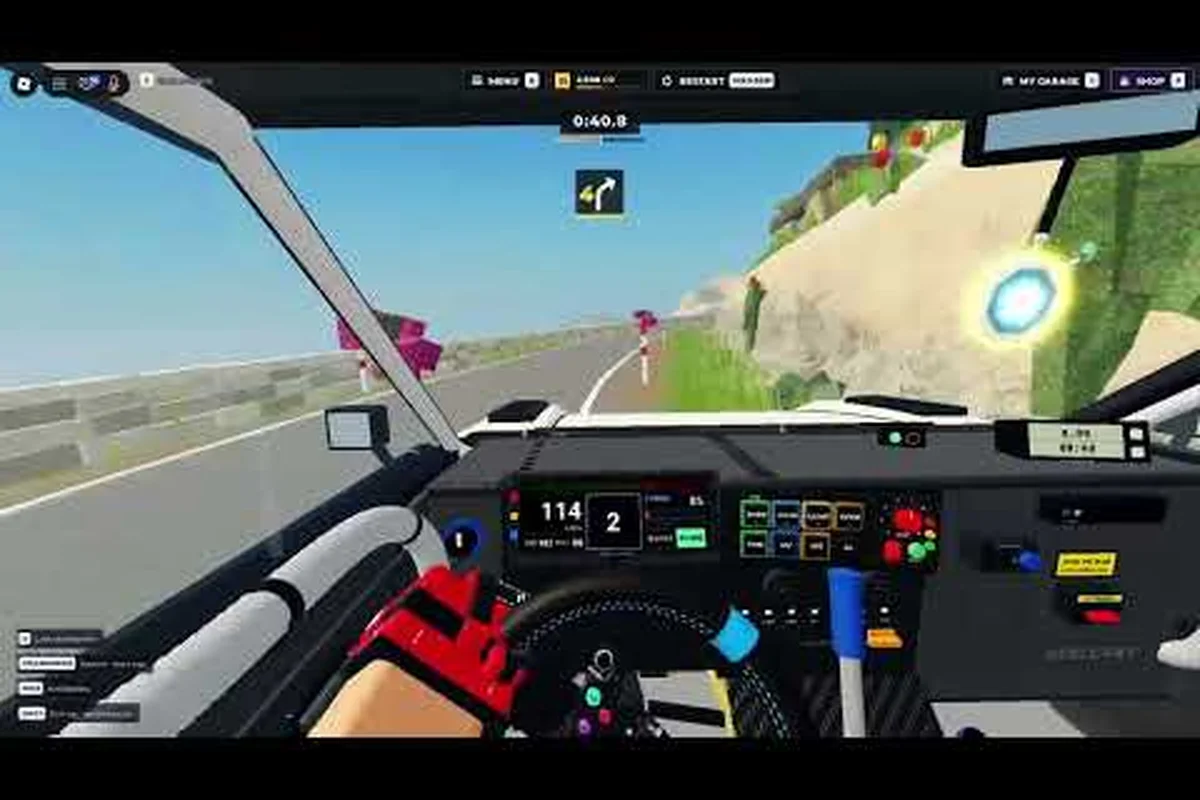
Backseat Rally stage 1 is where you learn the rhythm that carries into every later course: settle the car, read the turn, then commit. This walkthrough breaks down stages 1–5, the shortcuts worth practicing, and the mistakes that make a clean run feel slower than it should.
Backseat Rally Stage 1: The Basics Before the Faster Lines
Backseat Rally stage 1 establishes the basic racing language used throughout the opening courses. The road is relatively forgiving, but the corners still reward smooth throttle control. A driver who brakes early, rotates the car, and then applies power gradually will usually preserve more speed than one who reaches for the accelerator immediately after turning.
The important distinction is between slowing down and stopping. Many players arrive at a corner too quickly, slam on the brake, and then struggle to regain momentum. A better approach is to use the entire road width before the turn, enter with the car balanced, and release the brake as the steering begins to settle.
| Early-stage priority | What it controls | Practical adjustment |
|---|---|---|
| Entry speed | Rotation and understeer | Brake slightly before the bend |
| Throttle timing | Traction on exit | Add power gradually after turn-in |
| Steering angle | Tire scrub and instability | Use a smooth, moderate input |
| Car balance | Slide predictability | Keep weight centered through the corner |
| Look-ahead | Late braking and missed turns | Identify the next bend before the current one |
Start with a repeatable corner routine
A reliable routine gives you something concrete to repeat instead of reacting to every turn as it arrives. First, look through the corner and identify the intended exit. Next, move toward the outside of the road while braking. Then turn in, allow the car to rotate, and add power only when the vehicle is pointing in the correct direction.
The routine works because it separates braking, rotation, and acceleration into different phases. When all three actions happen at once, the car becomes difficult to control, especially on loose surfaces. This is particularly noticeable on later courses, where narrow roads leave less room to correct a mistake.
Community experience also supports keeping the first attempts conservative. A clean lap is more useful than a quick lap that ends in the guardrail, because stage 1 is also teaching the player how the car responds to the competition. Learn where the car settles, then gradually increase the entry speed once the line becomes repeatable.
Backseat Rally Stage 2: Finding the First Real Test
Backseat Rally stage 2 adds more demanding geometry without asking for the same extreme precision as the later stages. The course introduces tighter sequences, quicker direction changes, and more opportunities for a small steering correction to become a large slide. The main challenge is linking corners together instead of treating each bend as a separate event.
The important thing is to avoid arriving at the next corner with an unfinished recovery. If you run wide on one bend, do not add a sudden steering input to force the car back onto the ideal line. Let the car settle, release the accelerator, and make one smooth correction. The goal is not to imitate a perfect run immediately; it is to preserve a controllable rhythm.
Read the exit, not just the apex
Many missed corners in this section begin with a bad exit rather than a bad turn-in. Drivers focus on the apex, reach it successfully, and then accelerate too early. That extra power sends the car toward the outside edge, leaving the driver with no easy way to recover.
| Corner situation | Common mistake | Better response |
|---|---|---|
| Slow corner after a fast section | Staying at excessive speed | Brake earlier and settle the car |
| Fast corner followed by a short straight | Full throttle too soon | Delay acceleration until alignment improves |
| Tight left-right sequence | Steering at maximum angle | Reduce the first input |
| Road narrows after the turn | Drifting toward the shoulder | Use less power and a wider approach |
| Long bend with loose surface | One abrupt correction | Make gradual steering adjustments |
The exit-line discipline is the central lesson. When the car finishes a corner pointing slightly inward, you can accelerate and use that angle to help redirect it. When it finishes pointing outward, power will amplify the error. A quick glance at the road immediately after the turn can therefore save more time than a perfect apex.
The Backseat Rally level list is useful for seeing how this stage fits among the broader course progression. It also helps identify the kind of driving challenge each route emphasizes, from basic corner control to increasingly narrow and technical layouts.
Backseat Rally Stage 3: Three Route-Wide Decisions
Backseat Rally stage 3 is where route choice becomes more interesting. Instead of asking only whether you can turn the car, the course asks how much space you are willing to give up and how quickly you can regain it. The available Backseat Rally shortcuts are valuable because they can reduce distance or preserve momentum, but each one works only if its entry is clean.
A shortcut is not automatically the fastest line. Consider the surface, the exit, and the next corner before committing. A narrow cut that looks attractive on the map may require a sharp steering input, and a rough patch inside the turn can unsettle a car that is already rotating. The best route is the one that lets you keep the car stable through its entire length.
Evaluate shortcuts by exit speed
The useful question is not whether a shortcut saves distance, but whether it saves time after the exit. A route that cuts several meters but ends at low speed may be slower than the standard line. Look at the path after the shortcut and ask whether you can accelerate immediately, whether the car is pointed toward the next turn, and whether the surface can support the available grip.
| Shortcut type | Main benefit | Main risk | Best use |
|---|---|---|---|
| Inside cut | Shorter distance | Late steering and tire scrub | A corner with a clear exit |
| Outer bypass | Wider entry line | More distance and exposed surface | When the inside is blocked |
| Central cut | Better sightline | Uneven surface or hidden bump | After testing at low speed |
| Early-turn line | Better corner entry | Car pointed too far inward | Open corners with room to realign |
| Late-turn line | Greater apex speed | Very late braking demand | Smooth approaches and stable cars |
For consistent results, slow down before taking a new route for the first time. Learn where the road narrows, where the surface changes, and how the car settles after the cut. Once the shortcut becomes familiar, the car should arrive at the exit with enough control to accelerate toward the next bend.
Match the route to your current pace
If you are missing the same corner repeatedly, simplify your route before changing the car setup or expecting a faster shortcut. A reliable standard line provides a better foundation than a technically superior line executed with too much speed. Progress should come in layers: finish the corner cleanly, preserve exit momentum, and only then add a more aggressive route.
The shortcut commitment point is the moment when the car crosses the threshold where returning to the normal line would be more difficult than continuing. Before that point, stay flexible. After it, focus on the exit. Chasing the ideal center line while halfway through a shortcut is a common reason that a small saving becomes a large loss.
Backseat Rally Stage 4: Where Momentum Matters Most
Backseat Rally stage 4 raises the difficulty because a mistake now affects a longer sequence of corners. The course rewards drivers who can carry speed without losing control, and it exposes the weakness of a style built entirely around cautious apexes. Slowing down for every turn may keep the car safe, but it can leave too much time on the clock.
This is the point to separate two ideas that beginners often combine. Corner speed is how quickly you pass through one bend. Momentum is the speed you retain for everything that follows. A technically precise corner is not useful if the next section forces a complete stop, and a wide corner may be faster if it creates a stronger run into a tighter sequence.
| Driving choice | Immediate result | Longer-term effect |
|---|---|---|
| Late brake into a stable corner | Higher entry speed | More steering correction and tire scrub |
| Early brake with a clean exit | Lower entry speed | Stronger acceleration into the next section |
| Full throttle on exit | Rapid acceleration | Greater chance of a loose or wide slide |
| Delayed power release | Slower acceleration | Greater stability and cleaner alignment |
| Constant speed adjustments | Fine control | Easier to lose rhythm |
| One deliberate speed plan | More predictable response | Faster average through connected corners |
Keep the car ready for the next turn
A momentum-focused line does not mean accelerating blindly. It means choosing an entry speed that leaves enough grip for the next turn. At fast corners, the steering should be reduced so the car can rotate without excessive friction. At medium-speed bends, a brief pause on the throttle can settle the vehicle before the corner opens.
The look-through line becomes especially important here. Looking only at the current apex makes the car arrive at the next bend with a late reaction. By keeping your eyes farther down the road, you can prepare the throttle and steering before the current corner is complete.
Drivers should also expect weather to alter the feel of this stage. The Backseat Rally stage weather guide explains how changing conditions can affect grip and braking distance. On a slippery surface, preserve momentum through smoother inputs rather than forcing a hard rotation with sudden power.
Backseat Rally Mud Stage: The Toughest Medal Test
Backseat Rally stage 5 is the most technically demanding course in this opening group, especially when mud reduces traction. A verified Stage 5 record run by GakuranBoy demonstrates the key approach: use a momentum-focused racing line, brake early before off-camber sections, and keep the throttle steady through deep ruts.
The stage is not simply a slower version of the previous courses. It changes the relationship between steering, braking, and power. On mud, a hard steering input can push the car away from the intended line, while an uneven patch may interrupt the transition between braking and acceleration.
Mud changes the braking target
The visible road may look wide enough for a normal braking point, but the usable grip is lower. Brake earlier than you would on a firm surface, and keep the car straight while the weight transfers forward. Trying to rotate the car while heavy braking is still active can produce a sudden slide.
| Mud situation | Risk | Stable technique |
|---|---|---|
| Deep rut after a corner | Sudden loss of traction | Keep the throttle steady and avoid sharp steering |
| Off-camber section | Reduced lateral grip | Brake early and maintain a straight line |
| Puddled entry | Delayed acceleration | Exit the wet patch before adding full power |
| Rutted exit | Uneven wheel load | Let the car settle before turning |
| Soft shoulder | Weak support | Keep the inside tires on firmer ground |
| Slippery crest | Reduced front confidence | Avoid abrupt corrections at the top |
The steady-throttle rule is particularly useful in deep mud. Small, measured power inputs help the car pull through a rut, while a large application of throttle can create a sudden loss of grip. Steering should also be smooth because a correction made on a soft surface may be amplified immediately.
For medal-time goals, the Backseat Rally rain-stage guide provides additional context for wet routes and medal targets. The best time comes from reducing hesitation, not from driving recklessly. A slightly conservative entry that preserves a clean exit will usually beat a dramatic slide that costs several tenths.
Backseat Rally Shortcuts: Practice Plan and Common Mistakes
Backseat Rally shortcuts are most effective when treated as complete routes rather than isolated pieces of track. A shortcut includes its entry, the surface through the middle, and the first section of road after the exit. If any one of those parts is unreliable, the route is not ready for a medal run.
Start by driving each shortcut at a conservative speed. Identify the steering input needed to reach the opening, the point where the standard route would require a major correction, and the exact place where the car can accelerate again. This creates a clear mental sequence rather than an improvised gamble.
| Practice phase | Focus | Success marker |
|---|---|---|
| First run | Finding the entry and exit | Complete the route without contact |
| Second run | Reducing steering input | Reach the exit pointing correctly |
| Third run | Adjusting entry speed | Improve time without adding instability |
| Medal attempt | Holding one clean line | No hesitation at the commitment point |
| Weather test | Adjusting for grip | Use smaller inputs on wet surfaces |
| Repeated run | Building consistency | Similar time across multiple attempts |
Avoid the four most expensive mistakes
The first mistake is entering a shortcut before the car has finished slowing for the previous bend. The second is choosing the narrow line because it is shorter rather than because it is drivable. The third is accelerating before the car is aligned with the exit. The fourth is treating every weather condition as though the surface remains unchanged.
These errors often appear in a chain. A late approach produces excess speed, which causes a sharp steering correction, which unsettles the car, which causes an early or excessive throttle input. The time loss then grows through the next corner. A useful diagnostic is to identify where the chain began rather than blaming the final obstacle.
Build consistency with repeatable markers
Pick three or four visible points for each route: the turn-in marker, the commitment point, the exit marker, and the point where full acceleration becomes possible. Using the same references on every run teaches the hands and eyes to make similar decisions. That consistency matters more than making the most spectacular pass.
The route-readiness rule is simple: if you cannot explain where you will brake, rotate the car, and accelerate again, the shortcut is not yet ready for a fast attempt. This standard keeps the route consistent across attempts and makes mistakes easier to diagnose.
Frequently Asked Questions
Should I use every available shortcut in Backseat Rally?
Not automatically. A shortcut is worth taking when its entry is clear, its exit preserves speed, and the car remains stable through the middle. If the route requires a sharp late steering correction or ends pointing away from the next corner, the standard line may be faster. Practice each shortcut at a conservative pace before including it in medal attempts.
What is the best driving technique for Backseat Rally stage 1?
Use a consistent sequence: look through the corner, move toward the outside, brake before turn-in, rotate the car smoothly, and add power only after it is aligned. Stage 1 is best used to establish this rhythm, not to chase an aggressive entry speed. A clean exit and smooth acceleration into the next straight create the foundation for later stages.
Why do I slide in Backseat Rally stage 5 mud?
Mud reduces available grip, especially when braking, turning, and applying power overlap. Brake earlier, keep the car straighter while slowing, and use smaller, steadier throttle inputs after the turn. Deep ruts can also unsettle the car suddenly, so avoid abrupt steering corrections and allow the vehicle to settle before redirecting it.
How can I improve my Backseat Rally stage 4 time?
Focus on carrying momentum into connected corners instead of driving every bend in isolation. Choose an entry speed that leaves enough grip for the next turn, reduce steering when possible, and delay aggressive power until the car is aligned. Braking earlier with a clean exit often beats a late entry that creates instability through the following section.
Are Backseat Rally shortcuts useful for medal times?
They can be, but distance alone does not determine their value. A successful shortcut saves time only if the car reaches its exit at a useful speed and can accelerate without another major correction. Test the full route first, memorize the commitment point, and avoid changing the line on every attempt. Consistency around the shortcut is usually more valuable than a single risky pass.