
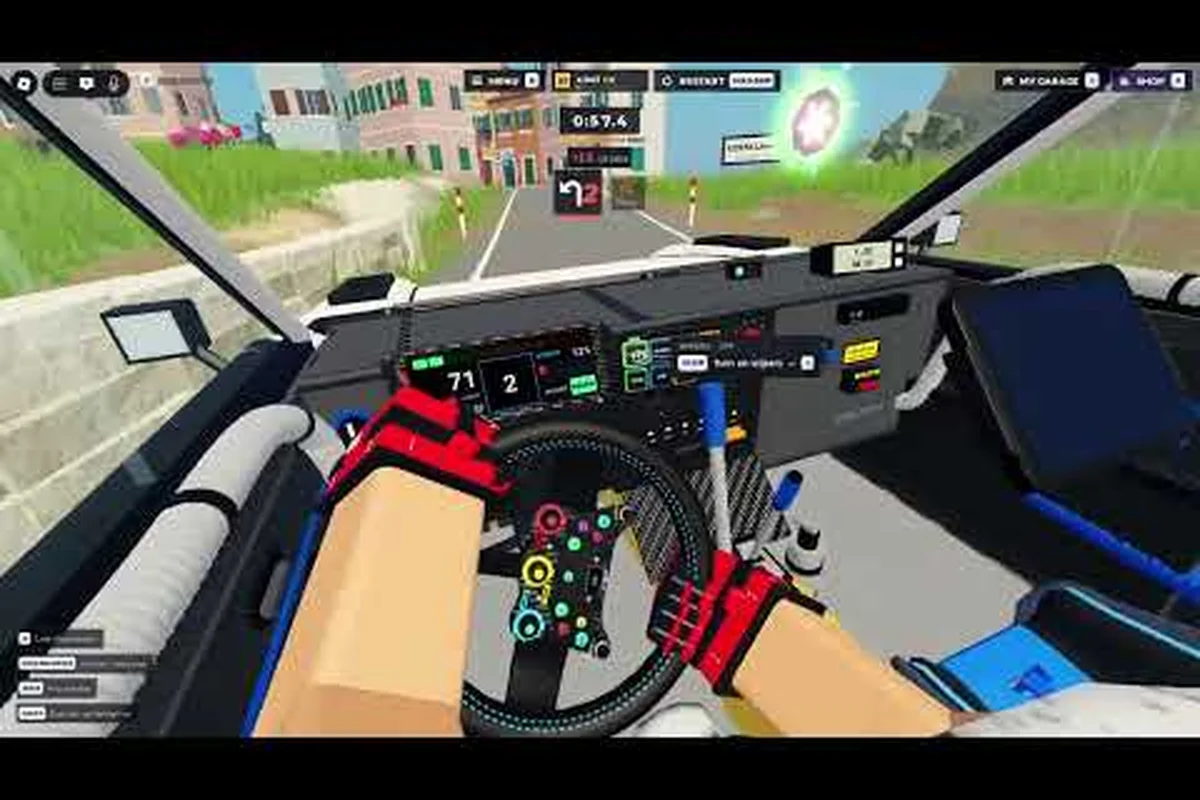
A strong Backseat Rally driving line turns every corner into a controlled arc, but the advantage comes from linking pace notes to visible map cues rather than simply carrying more speed. For example, a clipped inside line can tighten the exit while forcing a wider forest approach, whereas entering the junction later may preserve momentum for the next stage segment. Stage records and split times help identify where that balance is working: compare your Backseat Rally stage times against established runs, note whether losses begin on the corner or its exit, and use the Backseat Rally stage map guide to separate navigation errors from genuine driving-line mistakes. The result is a more repeatable line that protects speed without sacrificing the tighter exit.
Backseat Rally Driving Line Fundamentals
The most efficient line is not always the shortest path between two checkpoints. It is the route that lets you straighten the car, carry usable speed, and avoid losing momentum on a poor surface. That distinction becomes especially important when comparing a clean run with a time built from several small recoveries.
A useful Backseat Rally driving line begins with three separate decisions: where to place the car before the bend, how much steering to accept through its middle, and when to release the wheel for the next exit. Treat those decisions as one continuous movement because changing the steering abruptly at the apex can unload the rear of the car and make the exit less predictable.
What Makes a Fast Line?
A fast line has three measurable qualities: minimum rotation, maximum exit width, and controlled slip. Minimum rotation means taking the tightest practical arc without forcing a sudden change of direction. Maximum exit width means leaving the corner with the car positioned for the next straight or turn. Controlled slip means using the available movement of the vehicle without making the correction depend on a late save.
| Line choice | Immediate benefit | Main risk | Best use |
|---|---|---|---|
| Direct apex | Shortest visible route | Carrying too much speed into a tight exit | Open corners with a clear run-out |
| Late apex | Better view of the exit | Late steering can unsettle the car | Blind bends and changing terrain |
| Early apex | Faster steering response | Car may be pointed outward later | Tight hairpins with good acceleration afterward |
| Wide entry | More room to adjust speed | Long approach can reduce momentum | Sweeping bends and forest corners |
| Short entry | Less distance to build speed | Requires precise placement before the turn | Narrow roads and obstacle approaches |
The best choice depends on what follows the corner, not simply on the corner’s appearance. A forest route may reward a wide entry because the exit opens onto loose ground, while a snow route may favor a short entry that prevents the car from sliding toward a bank. These are surface-dependent lines, and treating both surfaces as if they offer the same grip is a common source of lost time.
Build the Line Before the Corner
Good driving begins during the approach. Read the road edge, identify the corner exit, and decide where the car should be when the turn starts. On a straight leading into a bend, that preparation may mean moving toward the outside early, but excessive movement can point the car into the inside bank and make the first steering input harsher than necessary.
A practical sequence is: identify the turn’s likely exit, select a usable approach position, and preserve enough forward visibility for the first steering input. On a fast forest-road bend, staying one car-width nearer the outside on entry can delay the initial turn-in and reduce the chance of clipping the inside verge, but moving too far out exposes the rear to the road edge. On snow, the same line should be smoother still, since abrupt changes in steering can unsettle the car’s balance and turn a clean corner into a slide. A Backseat Rally stage map guide can help flag the exit, but the line must still match the actual road width, camber, and surface visible through the windshield.
-
Scan two corners ahead rather than focusing only on the next apex.
-
Mark the intended exit with a visible roadside feature.
-
Settle the car before the steering input becomes urgent.
-
Rotate smoothly through the middle of the bend.
-
Unwind the wheel as the car reaches the chosen exit line.
-
Reassess grip before accelerating toward the next feature.
This sequence is especially helpful when a Backseat Rally stage map guide is being used to plan a route. The map can reveal the shape of a stage, but the driver still has to connect the planned features with what appears through the windshield. A good map note should say “right after the tree line” or “left before the rock,” because those references are easier to apply than a generic instruction to take the next corner quickly.
Reading Backseat Rally Stage Map Cues
A Backseat Rally stage map guide is most valuable when it translates shapes and landmarks into decisions. The objective is not to memorize every bend from above; it is to recognize, at ground level, the point where you should begin slowing, turning, or correcting the car’s position.
Maps often communicate a stage through a sequence of lines, corners, and surface changes. Learn the convention used by the stage, then relate it to the scenery visible from the cockpit. Broad curves may be represented as sweeping lines, sharp direction changes may be marked with tighter arcs, and hazardous edges may appear as boundaries or shaded sections.
Translate Map Symbols Into Driver Actions
| Map cue | What to look for on stage | Action before arrival |
|---|---|---|
| Long continuous curve | Road bending steadily into the distance | Choose a wide entry and stabilize the car early |
| Tight hook or hairpin | Road disappearing behind trees or terrain | Slow in a straight line, then rotate around the inside |
| Repeated bends | Alternating road edges visible ahead | Preserve enough steering lock for the second change |
| Surface transition | Change in color, texture, or debris | Adjust speed before the grip changes, not during it |
| Narrow passage | Close walls, branches, rocks, or banks | Make a precise placement and keep corrections small |
| Open section | Broad road with a distant exit | Build speed only if the next hazard remains clear |
The strongest map-reading habit is to pair each shape with a commitment point. For example, “the narrow section is at the map’s third bend” is less useful than “place the car on the left before the bend, then pass between the two marked edges.” A commitment point tells you when to begin the maneuver and prevents last-second steering corrections that waste speed.
Use Landmarks Before the Apex
Landmarks are especially valuable in forest stages because tall trees and rocks can hide the road’s direction. A player who depends only on the nearest bend may turn too early or too late. Instead, identify a lookahead landmark, such as a large tree, a slope crest, or a break in the roadside vegetation.
For practical map study, make a short cue list for each stage: note the driving line, the approach speed, and the exact point where the car should begin rotating toward the apex. On a forest stage, pair each entry with a visible lookahead landmark—a large tree, crest, or vegetation break—so a sudden visual obstruction does not cause an early or late turn. If a corner is blind, mark the last safe braking point and the required gear or hand-brake input; this keeps the next steering input tied to the stage map rather than to the nearest bend.
-
The first turn and its required approach position.
-
The location of the most dangerous surface change.
-
The corner with the best overtaking or passing opportunity.
-
The final bend before the finish or timing line.
-
A recovery area where a small mistake will not destroy the run.
A one-page route cue sheet with four or five entries is usually more useful than a dense diagram covered in arrows. Test it during a clean run, then revise any cue that was unclear in practice. The goal is to turn the map into a sequence of decisions that can be recognized at speed.
Backseat Rally Forest Route Tips
Forest stages reward drivers who can read the road through limited sightlines. Trees, shadows, uneven shoulders, and fallen material reduce the time available to make corrections, so the Backseat Rally forest route tips that matter most are about commitment and visibility rather than maximum steering angle.
A forest driving line usually favors a patient apex. Enter the turn with the car controlled, pass close enough to the intended apex to preserve the radius, and then let the car move outward as the road opens. Trying to hold the inside all the way through a blind corner can place the car directly into the vegetation or force a late brake input.
Forest Corner Priorities
The first priority is visibility. Before reaching a blind corner, slow enough that you can stop or adjust within the distance you can see. The second priority is line width. If the outside is soft or obstructed, the effective driving line may be narrower than it appears, which means the inside edge deserves more attention than usual.
The third priority is the exit. Many forest roads tighten again after a curve, so clipping the inside apex is not worth a wide, unstable exit. This is where the broader route knowledge in Backseat Rally route tips can help: the useful line is always connected to the road immediately after the corner.
| Forest situation | Recommended line | Common mistake |
|---|---|---|
| Blind right with limited exit view | Set up early, rotate around a committed point | Steering late and crossing the inside shoulder |
| Loose forest floor | Keep inputs smooth and moderate | Sudden corrections that dig into the soft surface |
| Tight trees at corner entry | Make one accurate placement before turning | Repeatedly changing direction near the apex |
| Fast bend after a short straight | Brake in line and release steering early | Entering before the car is fully settled |
| Narrow section with a widening exit | Stay central, then move outward | Treating the narrow section as a full-speed corner |
Watch the Road Edge
The painted-looking center or boundary may not describe the entire usable road. In a forest stage, the apparent edge can conceal soft ground, roots, or a drop. A clean visual edge reference gives you a stable target, but a clean surface reference tells you whether you can safely use it.
Avoid making one long steering correction while watching the scenery. Your attention should alternate between the apex, the exit, and the road edge in that order. If the exit disappears, keep the current arc and slow slightly rather than abruptly aiming at a new direction. A temporary loss of speed is usually cheaper than a trip into the trees.
For additional surface-specific adjustments, compare these techniques with Backseat Rally dynamic weather guidance. The underlying principle remains the same: lower grip reduces the amount of time available to complete a correction, so cleaner inputs matter more than more aggressive inputs.
Backseat Rally Snow Route Tips
Snow stages make small differences in momentum much more expensive. The car may accelerate gradually, stop more readily, and resist steering changes, so a route that works well on dry pavement can feel completely different when the surface is covered. Strong Backseat Rally snow route tips focus on smoothness, early planning, and avoiding abrupt load changes.
The central rule is to reduce the number of separate actions. Braking, turning, and accelerating at the same moment can make the car feel unstable even when each individual input seems reasonable. Try to complete the braking phase, settle into the turn, and then add power once the car is pointing toward the exit.
Preserve Momentum on Low-Grip Roads
Momentum is valuable on snow because acceleration may take longer than expected. A smooth, moderate turn can maintain speed better than a sharper turn followed by a long recovery. This does not mean carrying reckless speed; it means choosing an entry speed that lets you make one rounded steering movement without repeatedly catching the rear of the car.
| Snow condition | Line adjustment | Technique |
|---|---|---|
| Fresh or loose snow | Favor a cleaner, wider arc | Reduce abrupt steering and let the car rotate gradually |
| Packed snow with tracks | Follow a visible line where useful | Stay in the prepared path when entering and exiting |
| Icy patch | Avoid the edge of the change | Brake and straighten before the low-grip area |
| Shallow powder | Carry slightly more momentum | Keep the car balanced and avoid sudden throttle |
| Clear road between snow banks | Center the car with extra clearance | Do not clip a bank to shorten the line |
The timing of a turn matters more than its exact shape. Braking while sharply steering can reduce grip because the car is changing direction while decelerating. Where visibility allows, straighten the car, finish most of the braking, and only then begin the turn. On a narrow snow road, this may require an earlier commitment than on a broad dry corner.
Snow also changes where you should aim. A wide apex that remains on packed material may be faster than a short geometric line that runs over fresh powder. Use the usable surface width, not the road’s nominal width, when choosing your line. More context on these conditions appears in Backseat Rally winter driving tactics.
Manage the Snowy Exit
The exit is where many dry-road habits fail. If the car is still sliding at the moment you accelerate, power can exaggerate the rotation and send the car beyond the intended road edge. Let the steering begin to unwind before requesting more power, and add only enough acceleration to keep the car moving cleanly.
Use these snow momentum checkpoints throughout a backseat rally stage: reduce the slide before adding throttle, keep the car’s momentum aligned with the usable forest road, and unwind the steering only after the car begins to track again. On a narrow snow route, an early power surge can rotate the car away from the exit, so a controlled acceleration input preserves the intended line without sacrificing stage time.
-
The car is stable before the steering begins.
-
The route through the turn stays on usable surface.
-
The car points toward the visible exit.
-
The wheel can begin unwinding without a snap.
-
Acceleration increases gradually after the correction settles.
Treat the five snow momentum checkpoints as a diagnostic sequence, not isolated cues. A spin at the apex may actually begin with overlapping braking, steering, and throttle upstream: weight transfer unsettles the car before the apex, combined inputs prevent it from rotating cleanly, and the crew carries that error into the exit. On a forest route, one early overlap can cost more time than a later correction, because the car must first recover grip and then rebuild momentum toward the visible exit. A stage record or clean run depends on preserving the usable road line rather than merely reaching the apex quickly.
Backseat Rally Stage Times and Records
A clean driving line should produce a repeatable Backseat Rally stage time. If two attempts use the same route but differ by several seconds, inspect where momentum was lost rather than assuming the car simply drove faster. A useful stage-time review separates straight-line speed, corner entry, apex accuracy, and exit drive.
The clearest run is not always the fastest recorded run. A driver may save time with a risky move, clip an obstacle, or use a one-off slide that cannot be repeated. For long-term improvement, separate your personal best from your cleanest complete run. Both numbers reveal progress, but they answer different questions.
| Time category | What it measures | Best use |
|---|---|---|
| Personal best | The fastest completed run | Measuring maximum pace |
| Clean run | A controlled run with few major errors | Building consistency |
| Medal pace | Performance against the stage’s medal thresholds | Progression and competition goals |
| Stage record | The benchmark set by the fastest recorded run | Measuring the size of the remaining gap |
| Split comparison | Performance across sections of a stage | Locating where time is gained or lost |
Read Stage Records as a Reference
Backseat Rally stage records should guide expectations, not define an unrealistic target. Because conditions, vehicle behavior, and route choices can differ, a record time is most useful as a reference point for the pace required at key locations. The record run demonstrates that a corner can be taken quickly; it does not reveal every braking point or correction used on the way.
Community runs can also reveal whether a stage is usually completed cleanly. In the supplied reference, a community record video is labeled “Stage 5 Backseat Rally record” and credited to GakuranBoy. That provides a concrete example of a player-generated benchmark, but it should not be treated as an official or guaranteed target.
Diagnose Time Lost by Section
Divide the stage into logical sections: start, middle, and finish. Compare two runs and mark where the gap first appears. A large difference on a straight usually points to a cautious entry or an early mistake upstream. A difference at a corner points to the line itself. A late gap often means the exit was not prepared for the final straight.
| Observed time loss | Likely cause | Corrective action |
|---|---|---|
| Slow before a visible bend | Braking began too early | Move the brake point later and brake in a straight line |
| Fast entry but slow exit | Apex or steering transition was unstable | Smooth the middle of the corner and unwind earlier |
| Strong time loss after a mistake | Recovery consumed several corners | Reduce risk on the next attempt and rebuild rhythm |
| Inconsistent split times | Different route or line chosen | Use fixed map cues for each run |
| Small repeatable loss | Exit acceleration delayed | Prepare the car to drive out sooner |
A good improvement target is not “beat the record on the next attempt.” It is more practical: reduce the delay before the fastest corner, make the final exit repeatable, or remove one unstable input. Once the run becomes more consistent, the large time gaps usually shrink naturally.
Building a Repeatable Stage Routine
A repeatable routine makes it easier to test a new Backseat Rally driving line without changing several variables at once. Write down your intended plan before the attempt, then compare it with what happened. This turns a fast run into useful evidence rather than a vague feeling that the stage “felt good.”
Start with the stage map, but keep the plan brief. A useful routine has three layers: a route plan, a driving rhythm, and a post-run review. The route plan identifies landmarks and commitment points. The rhythm connects braking, cornering, and acceleration. The review locates the run’s most important time loss.
The Six-Part Stage Routine
-
Preview: Study the shape, surface changes, and hazardous areas before the attempt.
-
Commit: Mark the first corner where speed must change and the intended exit.
-
Carry: Preserve useful momentum on safe straights without arriving at a blind corner too quickly.
-
Rotate: Settle the car, use a smooth arc, and release the steering progressively.
-
Drive out: Apply power only when the car is aligned with the next road section.
-
Review: Compare the run with the previous attempt and choose one specific improvement.
A pre-run card with the map’s major landmarks and the intended action can make this routine easier to apply. Include words such as “brake straight,” “wide tree,” or “rock left,” because action-focused reminders are more useful than a page of generic advice.
Test One Change at a Time
Changing the line, braking point, and acceleration timing together makes it impossible to know what helped. For the next attempt, select one variable: move the brake point slightly, use a wider entry, or improve the exit. If the stage time improves without sacrificing control, keep that change. If it becomes inconsistent, reverse it before trying another adjustment.
This method is especially helpful when checking Backseat Rally stage records. Rather than copying a record run’s total time, isolate one corner and test whether a specific technique produces a better split. Eventually, the most valuable record data is the repeatable difference you can reproduce across several attempts.
Keep a Personal Stage Log
A simple log can show progress that a single best time misses. Record the stage, attempt date, final time, conditions if visible, the chosen line, and one lesson. A five-line log may look modest, but it can reveal repeated problems such as late braking or poor exits on the same corner.
Avoid rewriting the note immediately after a mistake. Wait until the next run, then describe what the car did rather than assigning a vague reason. “Turned too early, recovered near the rock” is more actionable than “bad corner” because it points to a specific visual and timing issue.
Frequently Asked Questions
What is the best driving line in Backseat Rally?
The best line is the one that fits the road, surface, and next corner. Use a smooth arc with a controlled apex, then leave enough room to accelerate toward the exit. The shortest visible path is not always fastest if it creates a sharp steering change, unstable load transfer, or a poor exit.
Where should the apex be on most Backseat Rally stages?
Place the apex near the inside only when the road supports a clean radius and the exit remains open. On blind forest bends or low-grip snow sections, commit to a slightly wider or more conservative arc. The priority is a stable car that can drive away from the corner without another emergency correction.
How can I compare my Backseat Rally stage times with records?
Compare both total time and stage sections because a single final number can hide where the gap began. Use a community or player record as a benchmark, not an official guaranteed target, and mark each corner where your run gains or loses time. The most useful record comparison is the repeatable pace difference at a specific exit.
What should I change if my Backseat Rally stage time keeps dropping in the same corner?
Inspect the approach, apex, and exit separately. Late braking calls for a straighter setup, an unstable middle calls for smoother steering, and a slow exit means the car is not yet aligned when power returns. Change one element on the next attempt so the result remains easy to evaluate.
Do snow routes need a different line from forest routes?
Yes, because snow usually changes grip, momentum, and braking distance, while forests restrict visibility and usable road width. Smooth the inputs and preserve momentum on snow, but choose your apex from the surface that will actually support the car. In forests, visibility and safe road edges matter more than a geometrically perfect arc.
A strong Backseat Rally driving line combines three repeatable habits: identify the next exit early, make one smooth transition through the corner, and accelerate only after the car is ready. Use map cues, compare stage times by section, and adjust snow or forest techniques to the surface so each improvement becomes measurable and repeatable.